
The French drain went in years ago. Maybe the last owner installed it; maybe you did. For a while it worked. Then, one spring in Sewell or Williamstown, after a few days of steady rain, a damp line reappears along the bottom of the basement wall. Or the yard by the downspout stays soggy for a week. The sump pump runs, but less water seems to be making it there.
Something’s wrong with the drain. The question is whether it can be fixed or whether it needs to come out.
It depends on where it failed. If the problem is in one spot, like a blocked outlet, a crushed section of pipe or a clog that can be flushed, a repair often does the job. But if the gravel and fabric around the pipe have filled up with silt, or the drain never had the right slope to begin with, there’s not much to repair. That kind of drain usually has to be dug out and rebuilt.
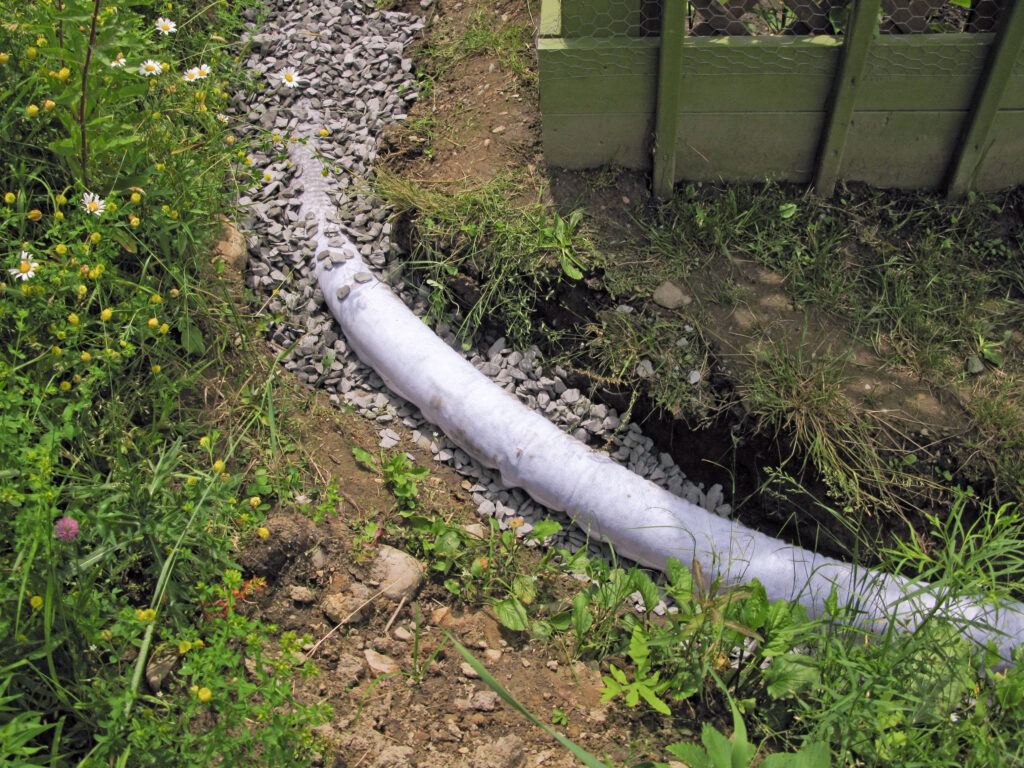
French Drain Repair or Replacement?
Repair or replace: the quick read
| What’s going on | Usually |
| Blocked outlet or discharge line | Repair |
| One crushed or broken section | Repair that section |
| Pipe clogged but gravel still clean | Flush or clear it |
| Gravel and fabric packed with silt | Replace |
| Drain has little or no slope | Replace |
| Water still coming in after a repair | Look closer, likely replace |
How a French drain actually fails
The idea is simple. Water in the soil finds its way into a trench full of gravel, gets into a perforated pipe, and that pipe carries it off to a sump or out to daylight. Less water sitting against the foundation means less pressure pushing it through the wall.
The weak point is dirt. Practical Engineering, an engineering education site, calls clogging the biggest problem with subsurface drains. Fine soil particles migrate into the gravel and the pipe over time. Filter fabric is supposed to stop that, but fabric clogs too. Stormwater magazine describes it as “blinding,” where clay and silt build up on the fabric until water can’t get through. Once fines get past it, they fill the spaces in the gravel, and then the drain is basically done.
That’s the crux of repair versus replacement. A pipe can sometimes be cleaned out. Gravel and fabric that are packed with silt can’t. You’d have to dig them out.
When a repair makes sense
When the trouble is in one place and the rest of the system is sound.
Maybe the outlet is buried under mulch or blocked by debris, and water’s backing up. Maybe a section of pipe got crushed by a truck or a landscaping job. Maybe there’s a clog in the pipe itself, but the stone around it is still clean. In cases like those, opening up one section, clearing the line or replacing a few feet of pipe can get things flowing again.
The key is finding out what’s really going on first. Guessing usually means paying twice.
When it’s time to replace it
Some drains were never going to last. Common reasons:
The gravel and fabric are full of silt, as above. Nothing to clean, it all has to come out.
The slope is wrong. Water needs to fall to move. Stormwater magazine points out that inadequate slope is often the original problem, and without enough of it, water just sits underground.
The design doesn’t fit the house. A drain in the yard can’t do much about water coming in at the base of a basement wall. Sometimes the fix isn’t a new version of the same drain. It’s a different system in a different spot.
What we look at first
Every job starts with a free inspection. We look at the whole picture: where the water’s coming in, grading, gutters, cracks, the floor and the existing drain. The point is to find the actual failure before anyone picks up a shovel.
When a drain needs to be built new, we install French drain systems at the footing level to catch groundwater before it gets in. The trench gets Grade 57 stone, which has about 40% void space, and a 4-inch perforated pipe with at least a 1% slope, carrying water to a sump pump. If the basement needs a full interior system, that work typically takes 2 to 4 days. Our French Drains and Basement Waterproofing pages go into more detail.
Sometimes the drain isn’t the real problem at all. Water coming through a crack in the wall needs Crack Repair, and water pouring in at a basement window is its own issue. See Basement Window Well Flooding: Why It Happens and How to Stop Water Entry.
Before you finish that basement
If you’re planning to drywall the basement, deal with the water first. A failing drain behind a finished wall is a much bigger and messier job. Read Can You Finish a Basement Before Waterproofing It? What Homeowners Should Do First before you start. And if you’re thinking about tackling some of it yourself, DIY Basement Waterproofing: What Works and When to Call a Pro lays out what’s realistic.
Frequently asked questions
Can a clogged French drain be cleaned?
Sometimes. If the pipe is clogged but the gravel and fabric around it are still clean, clearing the line can work. If the stone and fabric are packed with silt, the drain usually has to be replaced.
Why do French drains fail?
Clogging is the biggest problem. Fine soil works its way into the gravel and pipe, and filter fabric can clog too. Poor slope is another common cause.
How do I know if my French drain is failing?
Water coming back into the basement, soggy ground that stays wet after rain, or a sump pump that gets less water than it used to are all signs.
What slope does a French drain need?
Our systems use a 4-inch perforated pipe with a minimum 1% slope so water keeps moving to the sump.
Water back in the basement? DryMaster has been keeping basements dry since 1992 across New Jersey, Pennsylvania and Delaware. Call (609) 471-3458 for a free inspection, read our Testimonials, or contact us.


