
Can you? Sure. It’s your basement. But think back. Has it ever had a wet corner after a big storm? A damp smell in the summer? If so, putting up walls now just hides the problem behind new drywall, and you’ll pay to tear it out later. Water first. Walls after.
Look at what a finished basement is made of. Drywall. Fiberglass. Carpet. Wood studs. Not one of those likes getting wet. And if you ever need an interior drain, it goes in along the very edge of the floor, where the wall meets the footing. That’s exactly where your new wall would be sitting.
So the real question isn’t “can I?” It’s “what has to happen before the first stud goes up?”
The order that saves you money
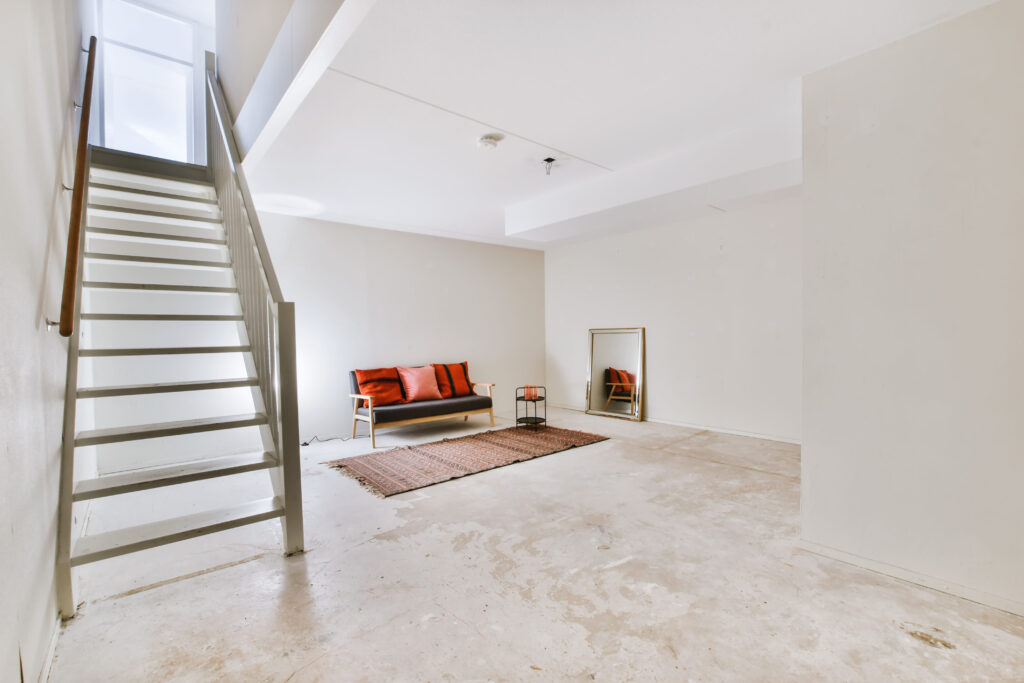
Basement Waterproofing
| Step | What you’re doing | Why it comes first |
| 1 | Look for signs of water | Tells you if there’s a problem at all |
| 2 | Run a simple moisture test | Catches dampness you can’t see |
| 3 | Fix gutters and grading | Cheapest water you’ll ever stop |
| 4 | Get an inspection | Finds where and why water gets in |
| 5 | Waterproof if needed | Drains and pumps go in before walls |
| 6 | Test for radon | Easiest to fix before finishing |
| 7 | Finish with the right materials | Foam, not batts and plastic |
How do you know if your basement needs waterproofing?
Start with your eyes and your nose. Cracks in the walls or floor. Damp spots. White chalky residue on the block. Peeling paint. A musty smell or mold. Any of those is a leaking basement telling on itself, and leaks don’t fix themselves. They tend to get worse.
Then look at the timing. A basement that’s bone dry in July can be a different story after a week of March rain, so think back over a full year, not just the last month.
Not sure? Try the plastic sheet test. Tape an 18-by-18-inch square of clear plastic flat against the concrete floor or wall, sealing all four edges, and leave it at least 16 hours. That’s the old ASTM D4263 method. Moisture or condensation on the underside of the plastic means water vapor is coming through the concrete. It’s a rough check, not a lab result. But it’s free, and it’s a lot cheaper than finding out after the carpet is down.
What should you fix outside first?
Gutters and grading. Every time.
Walk around the house the next time it rains hard. Where’s the water going? If the gutters are spilling over, or a downspout dumps right at the corner of the house, that water is soaking straight down next to your basement wall. Same if the yard slopes toward the house instead of away. So clean the gutters, add extensions to the downspouts, and fill in the low spots along the foundation. Building Science Corporation, a research firm that studies how buildings handle moisture, boils it down to four words: drain the site, drain the ground.
Window wells are worth a look too. A well that fills like a bucket in a heavy storm is a direct path into the basement, which we cover in Basement Window Well Flooding: Why It Happens and How to Stop Water Entry.
Sometimes this fixes it. Often it doesn’t, especially when groundwater is pushing up from below, and that’s when you need someone to find out exactly where the water’s coming from.
What happens during a waterproofing inspection?
Ours doesn’t cost anything, and Bud Lauria leads it. He’ll walk the outside of the house, look at how the ground slopes, measure any cracks, and check the floor. Inside, a moisture meter and a thermal camera show wet spots that look perfectly dry to you and me.
What he’s really after is the why. Water pushing in from the soil outside? A crack from the house settling? Dampness creeping up through the slab? Different causes, different fixes. And sometimes the answer is smaller than you’d expect.
Say you do need an interior system. Here’s what it involves. We cut open the floor along the walls, right at the footing. Perforated 4-inch pipe goes in, pitched so water runs to a sump basin. The walls get a liner so anything seeping through drips down into that drain. The pump gets a check valve and a battery backup, so a power outage during a storm doesn’t leave you flooded. Most New Jersey homes take 2 to 4 days. Now picture doing all that with finished walls and new flooring in the way.
Cracks that leak get their own repair. Our Crack Repair page explains when we inject and when a wall needs reinforcing.
Should you test for radon before finishing?
Yes, and do it twice. Once before you start, once after you’re done. The CDC is pretty firm on this one when someone’s turning an unfinished basement into living space. If the reading comes back at 4 pCi/L or higher, EPA’s advice is to have a radon reduction system put in.
Why before? So you have the answer while the floor is still bare and the walls are still open.
What materials should you use when you finish?
Once the basement is dry, build it so a little moisture won’t ruin it.
Building Science Corporation recommends rigid foam board or spray foam against the concrete walls, and warns against fiberglass batts there, since they can’t handle even minor leakage. It also says to skip the plastic vapor barrier on basement walls. That one surprises people. The plastic stops the wall from drying toward the room, so any moisture that does get in stays trapped behind the drywall.
Same idea on the floor. Building Science advises against impermeable floor coverings like vinyl directly on the slab, for the same drying reason.
And pull a construction permit. New Jersey’s Uniform Construction Code requires one for work on existing buildings, and turning a basement into living space counts.
Frequently asked questions
Can I waterproof a basement after it’s finished?
Yes, but the drain runs along the edge of the floor, right where finished walls and flooring sit. Doing it first keeps them out of the way.
How long does basement waterproofing take?
For most New Jersey homes, an interior system takes 2 to 4 days.
Should I put a vapor barrier on my basement walls before drywall?
No. Building Science Corporation advises against plastic vapor barriers on basement walls, since they trap moisture. Rigid foam against the concrete works better.
Do I need to test for radon before finishing my basement?
The CDC says yes, before you start and again after you finish.
Planning to finish your basement in South Jersey? DryMaster has been keeping basements dry since 1992 across New Jersey, Pennsylvania and Delaware. Call (609) 471-3458 for a free inspection, read about our Basement Waterproofing and French Drains services, check whether a DIY fix is enough in DIY Basement Waterproofing: What Works and When to Call a Pro, or contact us.


